

About the Project
EverWind, in partnership with First Nations, will develop, construct, and operate the Burin Peninsula Green Fuels Project, which will generate green hydrogen and ammonia using renewable electricity from wind and solar energy.
Power generation for Phase I includes 3 GW of onshore wind and 0.75 GW of solar, and future phases of the Burin Peninsula Green Fuels Project could represent an additional 7 GW of onshore wind and 1.75 GW of solar, making it one of the largest clean fuels production opportunities in the world.
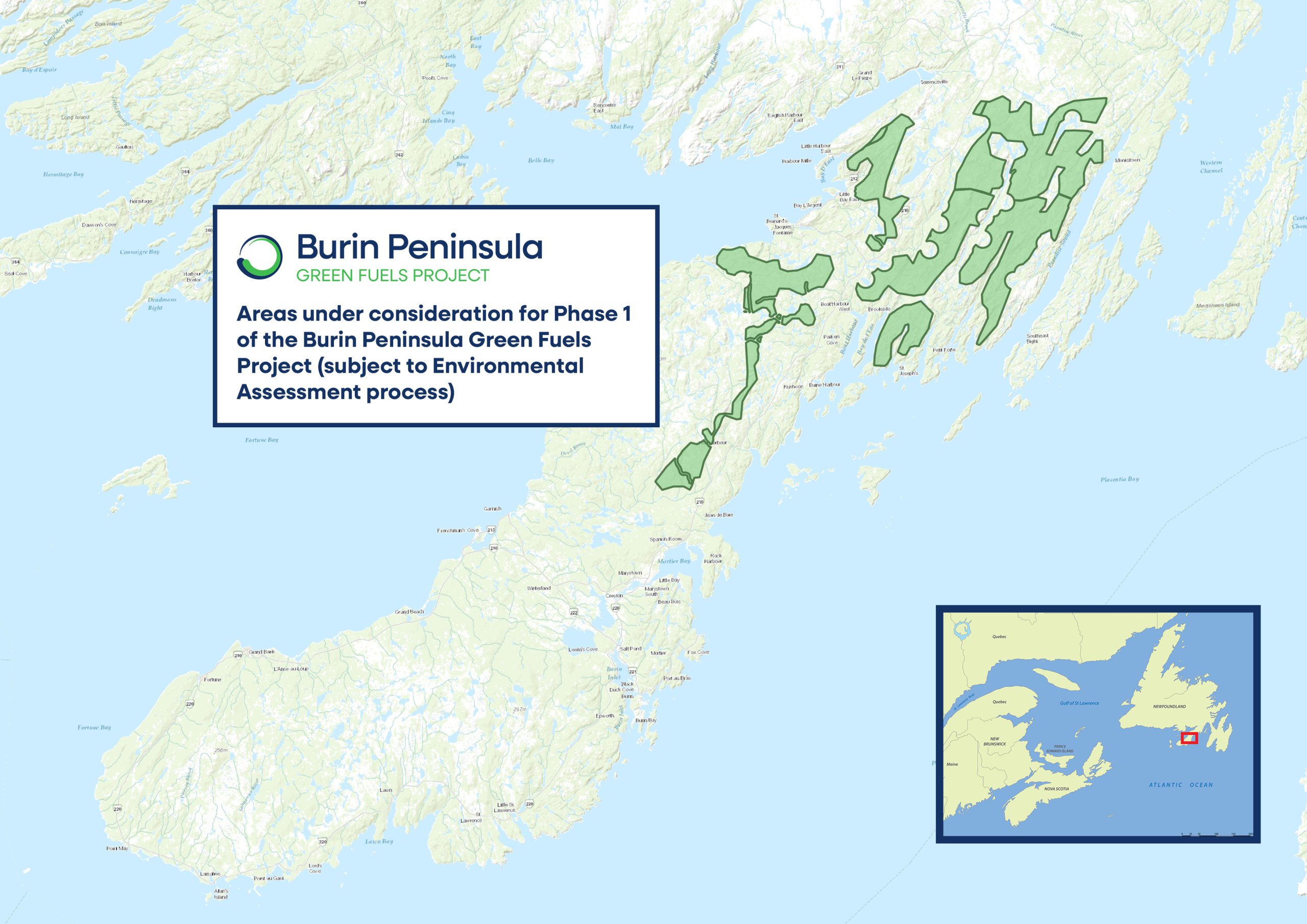
The middle Burin Peninsula (north of Marystown, south of Terrenceville) represents the ideal location for the Phase I wind and solar farms. The associated clean fuels production facilities will be located in Marystown, near a new multi-purpose open access marine terminal – Mortier Bay Marine Terminal. Phase I is expected to be an investment of approximately $16 billion, one of the largest in the history of Newfoundland and Labrador.
This project will contribute to Atlantic Canada’s clean energy economy. As we progress, our team will continue to study the site, working with residents to responsibly manage and mitigate impact on local communities and the natural environment.
Resources
Here you’ll find important documents related to the Burin Peninsula Green Fuels Project, including community presentations, one-pagers, and Environmental Assessments.
All documents are available for download in PDF format.
Benefits
The Burin Peninsula Green Fuels Project will bring substantial economic and social benefits to local communities. In January 2025, EverWind presented the Burin Peninsula Energy Board, representing over 40 communities, a draft of the Burin Peninsula Benefits Agreement. This document outlines the proposed benefits and commitments regarding the project, to ensure we are aligned economically, socially, and environmentally with residents of the Burin Peninsula. We are currently soliciting feedback on the agreement from key partners.

These benefits include:
- $107.5M in regional incentive payments during construction and operations, distributed directly to communities across the Burin Peninsula
- An estimated 5,500 jobs during construction and 500-750 direct and indirect operating jobs throughout the 35-year life of Phase I of the project
- Training and skill development opportunities
- Commitment to local procurement and supply chain development
- Increased local spending on goods and services during the project’s development, construction, and operational stages
- Significant provincial and municipal tax revenues throughout the life of the project
- Diversity, equity, and inclusion commitments
- High school bursaries and local donation programs
- Investments in telecommunication enhancements
- Winterland Airport upgrades (increased accessibility for critical air ambulance services)
- Development of local firefighting capabilities
- Regular project updates and regional benefits reports
Community Commitments
As the project proceeds, we are committed to working with local communities and the public, and maintaining open and honest communication, having completed over 60 information and engagement sessions across the Burin Peninsula since early 2022. Additional sessions will be conducted at various stages of the project’s development, as part of the Environmental Impact Statement (EIS) process outlined by the Department of Environment and Climate Change.
Our office in Marystown features a community feedback kiosk, encouraging the public to provide direct feedback to our project development team, engineers, and environmental scientists – including concerns about wildlife areas, areas for ATV riding, berry picking, hunting, etc. We recognize that these areas may not be captured in provincial databases, so we truly appreciate hearing more about them. See our contact information below to visit.
Community input plays a vital role in shaping our projects. We welcome your feedback and encourage you to stay involved as development continues.
The Burin Peninsula Green Fuels Project is guided by our commitment to environmental responsibility and sustainability. We believe that protecting the natural environment is essential to the long-term success of the project and the well-being of local communities.
Newfoundland and Labrador has a rigorous Environmental Assessment process which has been successfully administered on a wide variety of industrial projects over the years. As part of its project registration, EverWind committed to submitting an Environmental Impact Statement, which is the province’s most comprehensive environmental review pathway. We are working with several Newfoundland and Labrador-based environmental firms to ensure the project meets all provincial and federal requirements.
In March 2025, the Department of Environment and Climate Change released its Final Environmental Impact Statement Guidelines, which outline studies assessing all potential environmental, cultural, and socioeconomic impacts of the project.
These studies include:
- Terrestrial (bats, birds, plants, lichen, wetlands, wildlife)
- Aquatic (water quality, fish habitat, wastewater)
- Geophysical (geotechnical evaluations, groundwater)
- Atmospheric (air quality, noise levels)
- Socioeconomic (economic impact study, transportation impact study)
- Cultural/Heritage (historic resources assessment)
- Technical (e.g. human health, air quality, hydrologic assessment, solar glare hazard assessment, electromagnetic interference, greenhouse gas assessment, shadow flicker, visual simulations, noise impact assessment)
Given the significant scope of the studies outlined above, EverWind anticipates completing them throughout 2025, 2026, and 2027. Our objective is to submit the Environmental Impact Statement to the Department of Environment and Climate Change for review in 2027.
The Burin Peninsula Green Fuels Project will only be permitted to proceed to construction once it receives a full Environmental Assessment Release from the Provincial Government of Newfoundland and Labrador.
FAQ
EverWind is considering the wind farms for Phase I to be located on the middle portion of the Burin Peninsula, north of Marystown and south of Terrenceville. This area has strong wind, better terrain for construction and is located further away from local residents. EverWind is in the process of permitting four meteorological towers to better understand the wind and solar resources in the area.
EverWind is targeting 3 GW of onshore wind power generation in Phase I. The final number of turbines will depend on the final size of the project and the specific technology / model selected, but likely anywhere from 350 – 450 turbines. This is also dependent on the wind resource data we collect and the subsequent feedback we receive from residents.
The final height of the turbines will depend on the specific technology / model selected, but hub heights are expected to range from 100-135 metres tall.
When developing a wind farm, it is important to avoid placing the turbines too close together, which can lower overall production and efficiency of the farm. Generally speaking, turbines will be no closer than ~500 metres (equal to five soccer fields) from one another.
EverWind is currently focused on the first phase of the project located on the middle peninsula. In the event the first phase of the project is successful, there could be future opportunities to develop additional phases. Future phases would require additional community consultations and environmental approvals.
Each wind turbine’s footprint will require approximately one hectare of crown land, which includes the area for cranes and equipment laydown during construction. Once fully installed, the towers themselves only physically occupy approximately 10m by 10m pieces of land, similar to the footprint of a cabin or residential property. EverWind will also lease land for access roads, transmission lines and substations. The length of access roads and transmission lines will depend on the final layout of the wind farm. Similar to the wind turbines themselves, the location of this infrastructure will also take into consideration environmental sensitive areas such as scheduled salmon river watersheds, rare or sensitive fauna, migratory bird breeding habitats, etc., community and recreational land uses such as municipal drinking water reservoirs and watersheds, municipal planning boundaries, registered and unregistered cabins, and trail associations.
Yes, residents will continue to have access to the crown lands throughout the wind farm site. The only areas which will be fenced and off limits will be the ~10 substation locations due to safety considerations (similar to substations operated by NL Hydro and NL Power). Access roads for the project will be open to local residents and ATV users and will increase accessibility to the open country. Residents can continue hunting, fishing, and berry picking throughout the wind farm.
The Government of Newfoundland and Labrador enacted a freeze on crown land areas that are currently being evaluated for wind farm development across the province. EverWind does not control or own these lands, nor do we have the ability to unfreeze these areas. That being said, EverWind has provided a number of support letters to local residents and community organizations (e.g. ATV trail associations) in their applications for crown land in the frozen areas.
Although EverWind does not yet have a draft wind farm layout, turbines will be located at least 1,000 metres, or approximately 10 full soccer field lengths, from residential properties. Turbines will also be set back from cabins and ATV trails, and will be carefully considered during the environmental assessment process.
Green electricity and water are the two primary inputs in green hydrogen production. Current estimates indicate the project will require approximately 10-15,000m³ / per day, which is similar to other industrial projects in the area (e.g. former OCI fish plant – ~9,000m³ / per day, CFI mine – ~7,000m³ / per day), but substantially less than certain industries including pulp and paper (e.g. Corner Brook Pulp & Paper – ~38,000m³ / per day). The project will not impact municipal water supplies. EverWind has identified Linton Lake as a potential candidate to supply water to the project. Initial measurements indicate the lake contains over two billion litres of water, which is replenished by a larger capture area that is more than sufficient to supply the project for over 30 years, without materially decreasing the water level. Use of water from Linton Lake is controlled by the provincial government, which will review data provided on the lake and proposed usage as part of the Environmental Assessment process. The project will require approval from the province in order to use water from Linton Lake. EverWind will be required to pay for water usage at much higher rates than other industrial projects in the province.
Assuming development activities continue to progress, and that the project receives environmental approval, construction on the project would be anticipated to commence in 2028. EverWind anticipates the project requiring approximately four years of construction before achieving operations.
No, wind farms are not dangerous to humans or local wildlife or the environment. There are currently over 300 wind projects producing zero carbon energy across Canada, including two operating farms in Newfoundland and Labrador. Utility scale wind projects have been in operation across North America and Europe for over 50 years and the technology is safe and proven.
Wind turbines do create some noise as the blades travel through the air on windy days; however, the sound is subtle and generally exceeded by the sound of wind on the surrounding landscape. Within 500 metres of a spinning turbine, the sound is approximately 40 db(A), which is comparable to the sound level of the refrigerator in your kitchen. The sound produced by an operating wind farm is much lower than most industries or community land uses (e.g. ATV trails, highways, parking lots). As wind turbines will be located at least 1,000 metres from local residences, noise from the turbines will not reach them.
Like trees, hills, and buildings, wind turbines do cast a shadow in the opposite direction of the sun. The shadows themselves are not harmful to humans or the environment. As wind turbines will be located at least 1,000 metres from local residences, they are not anticipated to have any impact on local communities. As part of the Environmental Assessment, a shadow and flicker analysis will be performed. This data will be available for public review when the Environmental Impact Statement (EIS) is submitted and open for public consultation.
Wind turbines often have subtle blinking lights at the top of the tower as a safety precaution for nearby aircraft (i.e. similar to the lights on local cell towers). EverWind is exploring wind turbine models which have aircraft detection systems which would automatically turn the lights on / off. Operating wind farms create much less light pollution than most industries or communities (e.g. car headlamps, streetlights, business signage, light emitted from local residences).
Yes, despite being located away from local communities, the wind farm will be visible from different areas across the Burin Peninsula, including from some highways and ATV trails. This is no different than telecommunication towers or transmission lines today. The natural topography of the area will mean that from any given vantage point, the majority of the turbines will be located behind hills and rocky outcrops and not be visible.
Although bird strikes can occur on occasion, wind turbines are not a significant risk to local birds or avian wildlife on the Burin Peninsula. Studies in the United States indicate that wind turbines are responsible for ~0.04% of bird deaths (1). Passenger vehicles and cats are responsible for ~900 times and ~10,000 times more bird fatalities respectively than wind turbines in the US (1). At our Point Tupper terminal, we had the first wind turbine in Nova Scotia (owned by NSPI) built within our fence line; this area is regularly patrolled by our security personnel. In over 25 years of operation, not one dead bird carcass was discovered in the area of the turbine. EverWind has collected avian wildlife data from five specialized radar units located throughout the peninsula over an 18-month period. This data, alongside additional environmental studies will be incorporated in the Environmental Impact Statement submission. This data will be incorporated in the development of its wind farm layout, to minimize this risk further by avoiding migratory pathways.
1) U.S. Fish & Wildlife Service, Threats to Birds: Migratory Bird Mortality – Questions and Answers.
As part of the Environmental Assessment process, EverWind will be studying all valuable ecosystem components, including wildlife such as caribou, to understand any project and environment interactions and environmental effects. EverWind has been collecting data through a network of wildlife cameras located throughout the peninsula since November 2022. In partnership with environmental scientists, EverWind will develop mitigation strategies that will provide further protections to local wildlife during construction and operations. Construction phasing will move from one area of the site to the next, avoiding sustained construction works in a given area. Once operational, the wind farm will have limited impact on local wildlife including moose and caribou. Based on early environmental analysis of the peninsula, EverWind excluded the large area north of Garnish to avoid any potential interference with a legacy experimental caribou habitat that is no longer being actively managed or monitored by government.
The manufacturing process for wind turbines towers and blades does result in carbon emissions, like most industrial manufacturing today. Over time, as industrial manufacturing processes and utility grids around the world decarbonize (in large part through the availability of more green energy from more wind farms), the manufacturing processes for wind turbines themselves will also become cleaner. As wind farms produce massive amounts of zero emission green electricity, the net carbon footprint of wind farms is amongst the most environmentally beneficial of any product or service in the world.
Wind turbines produce a very small amount of vibrations from the blades and generator located inside the nacelle, which are transferred to the tower and foundation. These vibrations at the foundation are imperceptible and do not negatively impact local vegetation or wildlife.
Although harmless to humans and the environment, wind turbines can sometimes create potential interference with some specialized communication systems including weather stations, air traffic control towers, and cell phone towers. This is because the turbine blades have metallic lightning protection embedded in them for safety reasons, which can disrupt some signal types passing through the rotating blades. That being said, wind turbines are specifically positioned to avoid disturbance to these specialized systems. Electromagnetic interference is also reviewed as part of the environmental approval and permitting process for the project. Wind turbines will not interfere with cellular devices, emergency response radio, internet connectivity, or any other communication method on the Burin Peninsula.
No, wind turbines do not create emissions when they spin. As wind turbines rotate, the energy from the wind is used to produce one of the cleanest sources of zero carbon energy on the planet.
Wind turbines, similar to any electro-mechanical device or industrial equipment, have rotating components and hydraulic systems which require lubrication and maintenance. These systems operate together to keep the turbines safe, reliable, and delivering green energy day after day. EverWind will implement best in class preventative maintenance programs to ensure safe operations. Although every effort is made to proactively maintain the turbines, minor component failures can lead to leaks and egress of lubricants and oils. In some cases, these leaks may be visible on the towers or turbine components, but rarely result in fluids reaching the turbine foundations which have been cleared of organic materials. In the event of this type of failure, EverWind’s operation and maintenance team will remotely shut off the turbine and deploy its technicians to perform repairs and monitor the ground surrounding the turbine foundation for any signs of contaminants. Any required remediation will immediately be performed to avoid any negative impact on nearby vegetation or wildlife surrounding the turbine foundation. Wind turbines continue to be the safest and most environmentally friendly source of energy generation on the planet. We are also evaluating turbines that use electronic pitching systems instead of hydraulic pitching, which have no oil and thus no risk of leaking oil.
No, wind farms do not increase the windiness of a region or affect any of the regional weather patterns.
No, wind farms do not negatively impact the environment by changing the wind. The turbines only extract a small portion of the wind’s energy, therefore the wind will continue to blow down wind from the farm.
During winter months, it is possible for ice to accumulate on wind turbine components including the blades. Generally speaking, any ice accumulation simply falls to the base of the turbine. Ice throws from wind turbines are rare, and contained to the immediate vicinity of the turbines.
Similar to any electro-mechanical device or industrial equipment, wind turbines can catch on fire in very rare instances of mechanical failure. In the event of this type of incident, EverWind’s operation and maintenance team will remotely shut off the turbine and deploy its emergency response team and turbine technicians to manage the situation, perform repairs, and monitor the ground surrounding the turbine foundation for any signs of contaminants. Any required remediation will immediately be performed to avoid any negative impact on nearby vegetation or wildlife. In addition to ensuring proper fire and emergency training for our own personnel, we will offer training opportunities for local volunteer fire departments (VFDs) who are interested. Through our caring and sharing culture at EverWind, we’ve provided advanced firefighting training to multiple members of VFDs on the Burin Peninsula, who were invited to the world leading industrial fire school at Texas A&M. EverWind will continue to expand this training to other local VFDs as the project progresses. This training is intended to enhance the skills of these very important local departments – participants will teach their colleagues the lessons learned at Texas A&M to help further improve the emergency response capabilities in their own communities.
Wind turbine blades are safely secured to the rotor hub using a mechanically bolted connection. Any turbine showing signs of loose or failing blades, will immediately be shut off remotely by our site operations and monitoring team. In the very rare occurrence where a turbine is detached from an active rotor, the blade would likely fall to the base of the turbine. This does not represent a significant safety risk for neighboring communities or individuals passing by.
EverWind will exercise extreme caution in the vicinity of watersheds and waterways. EverWind uses vigorous internal standards in order to ensure these waterways are not negatively impacted by construction or operating activities. Appropriate bridges and crossing infrastructure will be implemented at water crossings. EverWind will also implement extensive water sampling and testing programs to ensure there is no impact on local waterways. These practices also apply to temporary crossings and permitted fording locations. EverWind has already implemented these protocols in the limited field activities we have done to date (i.e. MET towers). This approach is beyond the requirements that were stipulated in the multiple permits we received from various government departments such as crown lands, environment, and DFO.
Current wind turbine technology is designed for 30 operational years. However, in practice, turbines can continue operating even longer. If the project is commissioned in 2032, the cohort of turbines would be expected to remain operational into the 2060s.
Unlike mining and oil and gas projects, whose resources are depleted over time, green energy projects are intended to be perpetual in nature because the resource itself is renewable. The project will undergo a combination of minor and major maintenance activities throughout its life to ensure safe and efficient operations. As the wind turbines themselves approach the end of their 30-year useful lives, they can be replaced with new turbines. The project could potentially be fully repowered. Projects like these can repowered because the wind is renewable. The demand for clean electricity and renewable fuels is expected to increase over time. Once built, these projects could potentially produce clean energy for decades to come.
A project of this size will create a large number of jobs on the Burin Peninsula. During the ~4 years of construction, EverWind would anticipate the creation of ~5,500 direct and indirect jobs. It’s important to clarify that there likely won’t be 5,500 people onsite at any given time, as these jobs can vary between four weeks and four years, depending on the role. Once the project becomes operational, it is anticipated that 500-750 direct and indirect jobs will be created by the project. Unlike mining and oil and gas industries, these jobs will be perpetual in nature.
EverWind will be developing a project labor agreement which will accommodate a combination of unionized and non-unionized labor onsite.
The project is still in early-stage development, and the final go-ahead is only expected in early 2028. As such, job and supplier opportunities will start emerging in late 2027. To date, EverWind has received over 500 applications from residents on the Burin Peninsula interested in working on the project. The project will require most of the same trades, laborer, and operator skillsets as traditional industrial projects. EverWind will also be assisting with micro-credentials and role training as we approach project approval. If you are interested in providing your information ahead of time, feel free to submit here:
EverWind wants to maximize the opportunities available for local residents. Local labour is not only a best social practice, it also helps reduce overall project costs (e.g. lower travel and accommodation costs). In January 2025, EverWind presented the Burin Peninsula Energy Board with a first draft of the Burin Peninsula Benefits Agreement, which includes commitments to offering priority to qualified residents on the Burin Peninsula to ensure local communities get the most out of the project.
EverWind’s development capital is fully funded by our founder Trent Vichie. Given the size of the project,construction capital will be funded by equity partners and a combination of financial institutions including several of the Canadian banks.
The project will not cost tax payers anything. In fact, over time, the project will become one of the largest federal, provincial, and municipal tax payers in all of Newfoundland and Labrador.
In order to start construction on its project, EverWind will need to achieve Final Investment Decision (FID), which means all the capital required to build and operate the project is fully funded. Once operational, the project will be selling its green fuels on a fixed price contract for a minimum of 15-20 years (plus extension options). As such, green fuels projects of this nature are very financially stable, and much less likely to encounter financial challenges than mines or oil and gas projects, which face a combination of price fluctuations and resource extraction volatility which can impact their sustainability. As an added layer of protection, the province of Newfoundland and Labrador will also have site remediation obligations as part of the project approvals.
EverWind is open to offering clean power to the Newfoundland and Labrador grid if this is helpful to the province and provincial utilities who are currently evaluating these opportunities.
No, EverWind will be building its own wind farms to produce clean power for the project. EverWind may require some basic connection to the Newfoundland and Labrador grid to support backup systems, but this would be anticipated to be a small fraction of the project power. The project design does not plan to draw any electricity from the grid to produce hydrogen.
EverWind will be responsible for the construction of new roads, or upgrades to existing roads required for the project. The province will maintain control over existing road networks, which will be partially funded by tax revenues generated by the project. Given the challenging road conditions on the Burin Peninsula (i.e. single lane highways, hills, sharp turns), EverWind will be looking to minimize use of existing public road networks by delivering components by ship as close to site as possible.
EverWind is in the early stages of developing a comprehensive logistics strategy which will minimize impact on local road travel as much as possible. There will undoubtedly be certain stretches of road that will require upgrades, which may cause some temporary disruption (similar to typical road works and maintenance), but these should be relatively limited.
Yes, new access roads built by EverWind will be accessible to the public. During the construction phase, active construction sites will be temporarily off limits to ensure the safety of local residents as well as construction crews. Once the site is completed, access will be reestablished.
The provincial government will continue operating hospitals and other public services on the Burin Peninsula. The level of public services offered to communities across the province are based on two primary factors: population levels and tax revenues. The Burin Peninsula has experienced a sustained reduction in public services (e.g. healthcare, education, etc.) over the last ~40 years as the population dropped from nearly 30,000 residents in 1986, to less than 19,000 residents in 2021 (estimated at ~17,800 today, representing a 40% decrease). The rapid population decline and shrinking tax base will continue driving a reduction of public services available on the Burin Peninsula over time, which will increasingly be relocated to the greater St. John’s area.
EverWind’s project will help stabilize the population on the Burin Peninsula and drastically increase the provincial tax base in the region, ultimately supporting an increase in public services. Given EverWind will be prioritizing jobs for residents on the Burin Peninsula, the population will only increase by the labour force we are unable to source locally. This will result in some level of population increase, which based on very preliminary estimates would be ~5%. The Burin Peninsula will unlikely return to the population levels it once had, but sustaining its current population with some level of growth will be crucial to maintaining public services on the Burin Peninsula.
Yes, EverWind is hoping to upgrade regional cell service in the area by erecting additional telecommunication towers across the Burin Peninsula. This will be critical to ensure communications with employees in the field, and serve as a free benefit to local residents.
No, EverWind will not be taking anyone’s home or cabin. EverWind has access to all the registered provincial databases to ensure the eventual layout of the wind farms do not overlap with homes or cabins. The more information we can gather on remote cabins the more likely we can avoid them during the development planning stage. This information is for internal purposes only and will not be shared with the government.
No, ATV trails will remain open to the public. EverWind’s access roads will also be accessible to ATV users, maintaining access to remote country.
Yes, EverWind has been actively engaging with communities on the Burin Peninsula since April 2022. To date, EverWind has completed >60 community sessions on the Burin Peninsula open to the general public, which is more than all other green energy projects being contemplated in Newfoundland and Labrador combined. Open and honest communication is one of EverWind’s fundamental principles, and has been part of our development activities at the very beginning.
No, EverWind has not yet been awarded a project or crown lands. On August 30, 2023, EverWind was awarded the right to continue its development activities on the Burin Peninsula, by receiving a Crown Land Recommendation Letter. This Recommendation Letter was part of the provincial government’s crown land for wind development process which was initiated in July 2022. In total, the province received a total of 73 project applications, and selected the top four projects to receive a Recommendation Letter (including EverWind). The project still needs to complete the comprehensive Environmental Assessment process before being awarded crown lands necessary to proceed.
In order to proceed with the project, EverWind will need to receive environmental approval from the province through the Environmental Impact Statement (EIS) process. The EIS process in Newfoundland and Labrador is a comprehensive review of all potential impacts of a project – including environmental, economic, social, community, and other. The EA process has been in place for many years, and has been used to assess a number of projects across several different industries including mining, oil and gas, aquaculture, and others.
The EA process has two primary steps:
- Registration – Province reviews summary information and provides project specific guidance regarding the need for more data and analysis. In September 2024, EverWind completed its Environmental Assessment Registration Document.
- EIS Submission – Province reviews comprehensive analysis of all potential impacts of the project and associated mitigations. This is a comprehensive document including several thousand pages of information and is reviewed by dozens of governmental departments and subject matter experts. In March 2025, EverWind received the Final EIS Guidelines from the Department of Environment and Climate Change. These guidelines will help inform the environmental and socioeconomic studies to be completed in 2025 – 2027. EverWind anticipates submitting its EIS in mid-2027. Once submitted, the province has 90 days to provide feedback.
No, the Environmental Approval process for green energy projects is managed by the provincial government and final approval is made by the Department of Environment and Climate Change. During the environmental approval process, proponents are responsible for collecting and analyzing environmental, economic, social impact data on their projects. They are also responsible for developing proposed risk mitigation strategies to minimize the potential impact. All costs associated with these activities are paid for entirely by the proponent. For a project of this nature, the preparation for an environmental approval application will cost tens of millions of dollars and can take ~3-4 years to complete. Once this information is prepared, it is submitted to the provincial government, who will complete a comprehensive review and evaluation of the data. During this process, several different departments, stakeholders, and subject matter experts review the data to see if they agree or disagree with the findings and proposed mitigation strategies. This process can take time, given the need for clarifications, additional information, and consultation. When ready, the Department of Environment and Climate Change will make a final decision to approve or reject an application, or approve an application with certain conditions. The environment approval process in Newfoundland and Labrador is amongst the most comprehensive in North America, and has been used successfully to review a number of major projects across industries. The overall evaluation approach is similar to the regulatory review processes for other regulated sectors across Canada, the United States, and Europe (e.g. industrial projects, healthcare, transportation, etc).
Please feel free to swing by our office in Marystown, at Suite 201, 215-217 Ville Marie Drive. Questions can also be submitted to us at info@burinpeninsulaproject.com
Stay Up to Update
Keeping the community informed is important to us. For regular updates, press releases, newsletters, community notices, and other project-related materials, visit our Resources & Media page.
Contact
We welcome your questions, feedback, and inquiries about the Burin Peninsula Green Fuels Project. Feel free to get in touch or stop by during office hours. We’re here to help.
Address:
215-217 Ville Marie Drive, Suite 201
Marystown, NL, A0E 2M0
Email:
info@everwindfuels.com
Phone:
(709) 567-3370
Office Hours:
Monday – Friday
8:30 a.m. – 4:30 p.m.
These hours are subject to change.
If you have questions about our other projects, feel free to contact us.
More Projects
Point Tupper Green Fuels Project
EverWind, in partnership with Mi’kmaq First Nation communities of Paqtnkek, Potlotek, and Membertou, is jointly developing, constructing, and operating the Point Tupper Green Fuels Project. This is an industry-leading clean energy initiative and the first of its kind in Canada.
Bear Lake Wind Project
In partnership with Membertou First Nation, the Bear Lake Wind Project will generate up to 88 MW of wind energy across West Hants Regional Municipality, the Municipality of the District of Chester, and Halifax Regional Municipality in Nova Scotia. The project received Environmental Assessment Approval in December 2023.
Kmtnuk Wind Project
In partnership with Membertou First Nation, the Kmtnuk Wind Project will generate up to 128 MW of wind energy in the Municipality of Colchester, Nova Scotia. The project received Environmental Assessment Approval in December 2023.
Windy Ridge Wind Project
In partnership with Mi’kmaq First Nation communities of Paqtnkek, Potlotek, and Membertou, the Windy Ridge Wind Project will generate up to 376 MW of wind energy in the Municipality of Colchester, Nova Scotia. The project received Environmental Assessment Approval in July 2024.
Upper Afton Wind Project
In partnership with First Nations, the Upper Afton Wind Project will generate up to 176 MW of wind energy across the Municipality of the County of Antigonish and the Municipality of the District of Guysborough, Nova Scotia. The project’s Environmental Assessment was registered in March 2026.
Guysborough Wind Projects
As Phase 2 of EverWind’s wind farm developments, the Guysborough Wind Projects, Setapuktuk Wind Project, Wind Farm 2, and Wind Farm 3, will deliver up to 2.5 GW of clean power in partnership with First Nations. These projects will generate lasting local benefits, create jobs, and power EverWind’s Point Tupper Green Fuels Project, connected via the Strait Crossing Transmission Line Project.
